

Every successful relationship, personal or professional is built on the foundations of cooperation, collaboration, and teamwork. Sharing time, money, or resources makes the world a kinder and happier place. This is a quality that must be built in the young generation at the earliest. Kids ‘R’ Kids, an educational preschool in Valrico, shares some tips on imbibing this wonderful quality of sharing in children.
.png)
The ability to share is directly related to empathy. Children are developmentally able to share only when they are cognitively able to understand another person’s point of view. Young children are naturally very egocentric. They have difficulty seeing anything outside their point of view. Studies show that during the ages of approximately 2 – 7 years old, children are slowly learning to understand that others have different thoughts, perspectives, and ideas than their own. Sharing will be vehemently resisted by this age group as they are only just beginning to understand other people’s points of view.
Like any developmental milestone, there is an age when children can be expected to share. And just like any other skill, sharing takes practice, time, and positive reinforcement.
Sharing transcends objects. It is not just about sharing a favorite toy but also about sharing time and resources. A child who waits his turn to play is sharing his time and patiently waiting for the other child to finish his turn. A child who is investing time and energy to console a friend is sharing.
By modeling, this behavior at every opportunity adults can encourage children to share.
The developmental milestone of sharing may not have been achieved yet but the language of sharing can be taught and reiterated at an early age. Toddlers can be explained how a younger child needs more attention at one point and that they must wait their turn to receive the desired attention. Helping children assign words to their feelings while waiting for their turns can help. Praising the children for their ability to share can also give them the confidence to repeat the action.
Games that require children to cooperate and wait for their turns are a great setting to learn to share in. For instance, taking turns while playing a board game or putting together a puzzle allows children to practice sharing with others.
Children don't need to share everything, every time. A favorite toy could become a bone of contention and is, therefore, best kept away during playdates, for instance. It’s important to set up children for success by not forcing them to share something special with them. Giving them the liberty to choose to share their favorite toys may help them be more willing to share later.
A heads-up on a possible situation where they may have to share allows children to process the information and be prepared. A simple explanation of the situation can go a long way. For instance, informing the kids that a family is coming over with two kids for dinner, and they all can play with their toys together. Also giving them an option of keeping away their favorite toys sets up the children for success during the social interaction and gives them the freedom of choice.
Positive reinforcement lies at the foundation of all learning. Therefore, children must be praised when they gracefully share their toys with their peers. On the other hand, escalating the situation and trying to force a child to share does not have a positive effect in the long run. Suggesting an activity that requires all children to work together such as play-doh or coloring may diffuse the pressure of sharing and give them the comfort of choice and liberty. They may feel comfortable eventually sharing and must be showered with praise for their efforts.
.png)
The philosophy of “Hug First, Then Teach”, defines every aspect of what Kids ‘R’ Kids, Valrico stands for. Unlike many daycare centers or childcare providers, its methodology is a whole-child approach. It constantly strives to strengthen and encourage every child’s emotional, intellectual, social, and physical well-being through the expertise of its childcare providers and a unique partnership with parents.
Kids ‘R’ Kids International is accredited by AdvancED®, the world’s largest education community, and the Southern Association of Colleges and Schools Council on Accreditation and School Improvement (SACS/CASI). SACS/CASI is an accreditation division of AdvancED®. This accreditation ensures that the high accreditation standards are met and exceeded.
Early childhood is the time for setting a strong and balanced foundation for future success. Every parent and teacher aims to raise and educate their children to become well-rounded, confident, self-motivated, and independent adults. Kids ‘R’ Kids, an educational preschool in Circa Fishhawk, shares some important tips for parents to set up their children for success at school and in life.
.png)
Play is the most underrated yet most impactful form of learning for young children. Children must engage in free play every day beside the structured play at school and home. Extracurricular activities are great for kids but their creativity and problem-solving skills are best developed during unstructured play.
Reading to children opens up a whole new world to them. Reading not only enhances their language skills, imagination, and critical thinking skills, and also encourages parents-children bonding. Reading helps develop children’s emotional maturity and helps them assign words to emotions they feel. This is an activity that allows a dialogue and discussion between children and parents that encourages thinking and communication.
Independence is a life skill that must be taught to children early. Allowing a child to make mistakes and learn from them to make better decisions is a skill that will make a massive difference in their lives as adults. Parents can begin teaching this skill by allowing children to resolve their conflicts with friends among themselves, encouraging them to do some homework independently, packing their bags every day, and taking responsibility for some age-appropriate chores.
The American Psychological Association states that grit is what separates the very best from those who are simply good enough. Angela Duckworth, a psychologist at the University of Pennsylvania, found in her research that a combination of grit and self-control, reliance, and ambition were the most reliable predictors of a positive outcome, rather than intelligence. The kids who won the spelling bee, for instance, weren’t necessarily smarter than their peers; they just worked much harder at studying the words.
Parents can offer challenges to children to work through and overcome. Adversity and even failure are critical to a child's development.
All children have different strengths, weaknesses, interests, and passions. It is children’s emotional need to be accepted as individuals and be allowed to pursue their natural inclinations.
Giving children the opportunity and the encouragement to experience all extra-curricular activities at school such as drama, music, dance, and public speaking besides academics is crucial for their development. Children must be allowed to indulge in activities they feel naturally drawn to. These interests may convert into valuable career choices later on.
Distress, disappointment, frustration, relief, anticipation, anger, fear… these are emotions that are a part of everyone’s life. Protecting children from these experiences can weaken their ability to handle adversity later in life. Children must experience disappointment and acquire the skills to cope with this emotion. Not having these skills when parents are not around to help can prove to be a huge source of stress. So disappointment is good.
Children must cross certain developmental milestones before they are ready to acquire certain skills. Forcing certain skills such as reading, writing, and math skills before children are developmentally ready can lead to learning gaps later on. Pushing children to learn something they are not ready for not only disrupts their foundational skills but also takes away invaluable time they would have spent in free play and in exploring their curiosity.
Adults are accountable for their actions. And this ability to accept accountability must be taught at an early age. For instance, if children leave their toys all over the floor, they are expected to collect them. If they hit another child, there are consequences. This is a life skill required in professional as well as personal equations.
.png)
The philosophy of “Hug First, Then Teach”, defines every aspect of what Kids ‘R’ Kids, Circa Fishhawk stands for. Unlike many daycare centers or childcare providers, its methodology is a whole-child approach. It constantly strives to strengthen and encourage every child’s emotional, intellectual, social, and physical well-being through the expertise of its childcare providers and a unique partnership with parents.
Kids ‘R’ Kids International is accredited by AdvancED®, the world’s largest education community, and the Southern Association of Colleges and Schools Council on Accreditation and School Improvement (SACS/CASI). SACS/CASI is an accreditation division of AdvancED®. This accreditation ensures that the high accreditation standards are met and exceeded.
Call today at (813) 654-7000 to learn more about the Kids ‘R’ Kids before and after school programs (Kindergarten to Grade 5) or to schedule a visit.
Early childhood is a very crucial time for the cognitive development of a child. Parents need to understand how a child’s brain develops and support this development. Kids ‘R’ Kids, an educational preschool, shares important facts about early cognitive development and tips to encourage this development in preschoolers.
Jean Piaget's theory of cognitive development suggests that intelligence changes as children grow. A child's cognitive development is not just about acquiring knowledge; the child has to develop or construct a mental world model.
Cognitive development occurs through the interaction of innate capacities and environmental events, and children pass through four stages. Each child goes through the stages in the same order, and child development is determined by biological maturation and interaction with the environment. The four stages are the sensorimotor stage (birth to 2 years), preoperational stage (2-7 years), concrete operational stage (7-12 years), and the formal active stage (12 years and above). Here’s more about the preoperational stage that is relevant for preschoolers.
Children in this stage are learning to use language and think about the world symbolically. These skills help children develop the foundations to use operations in the next step consistently. A child’s thinking is dominated by how the world looks, not how the world is. It is not yet capable of the logical (problem-solving) type of thought. Children at this stage also demonstrate animism. This is the tendency for the child to think that non-living objects (such as toys) have life and feel like a person’s.
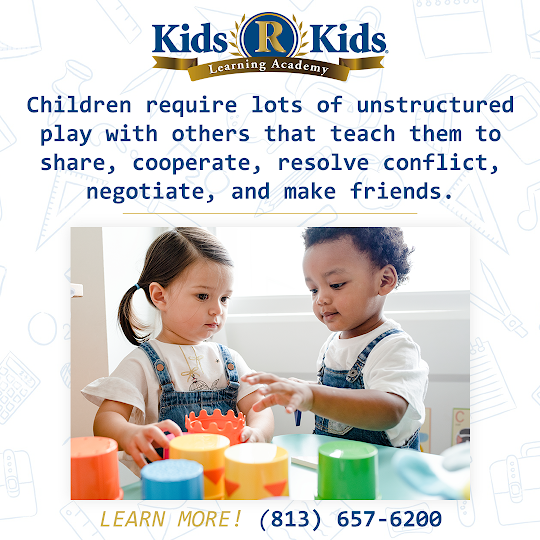
Play is a vital component of cognitive development in early childhood. It also allows parents to engage with their children. Parents can build an affectionate and loving relationship with their children to become the foundation for their development and learning.
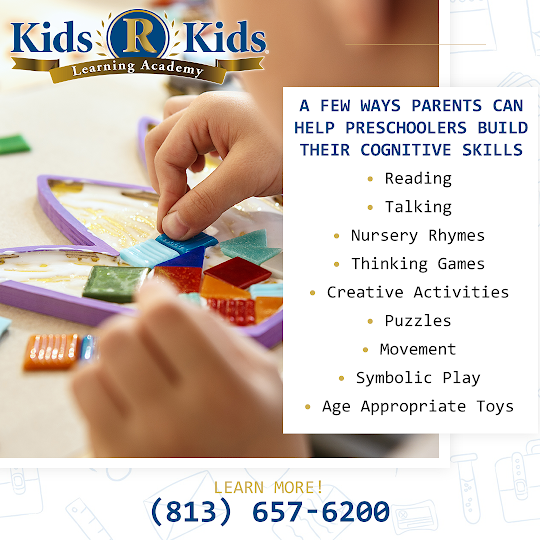
Preschoolers learn best through child-led or even adult-guided play. Children require lots of unstructured play with others that teach them to share, cooperate, resolve conflict, negotiate, and make friends. Here are a few ways parents can help preschoolers build their cognitive skills.
Reading daily to children is a great way to help their cognitive development. It helps develop the following skills:
Vocabulary
Language patterns
Thinking skills
Writing skills
Problem-solving abilities
Attention span
Memory
Listening skills
Talking with children about their day at school, their experience with an activity, about their friends, during a bath or a walk allows children to use the language they are hearing. Parents are the primary source of vocabulary for children in the early years. Since children learn by imitation, parents must use grammatically correct language that stimulates a child’s mind.
Nursery rhymes are not only entertaining for children; they also teach language patterns and vocabulary and help build auditory perceptual skills. Classic nursery rhymes, songs, and poems are rich in language constructs that can help set up children for reading success later on.
Critical thinking skills are crucial for a successful adult. Thinking “outside the box” and creative problem-solving can be built by playing various thinking games. Games such as the guessing game, the prediction game, pretend-play game, and memory games are all meant to develop different thinking skills in children.
Creativity involves two processes - thinking and producing. Creative thinking helps the brains develop neural connections and learn new concepts. It fosters mental growth in children by providing opportunities to experiment with new ideas, new ways of thinking, and problem-solving. Activities such as drawing, painting, molding, creating something with waste materials, or pretend-play are forms of creative expression. Parents can provide opportunities, materials, and stimulation for children to develop creative skills.
Puzzles require a lot of concentration and effort, and perseverance to complete. Children who solve puzzles develop deep thinking and intellectual capabilities. Parents can present children with challenging yet doable puzzles appropriate for their age.
Movement helps build neural pathways in the brain. It helps in the development of gross and motor skills among children. Exercise wakes up, resets, and re-energizes the brain. Therefore, it can be used to reset a child’s concentration during any activity.
Symbolic play is when children use objects to represent other objects during make-believe play. A highly creative form of play, extended play enables children to develop advanced intellectual skills.
During this kind of play, children invent new ways to act out their world to make sense of it. Parents can offer access to toys and materials to encourage this play.
A stimulating environment for a child does not require fancy toys or equipment. Basics such as wooden blocks, Lego, playdough, books, construction materials, and natural materials can be offered to children on alternative days or after every few days. Children are encouraged to invent novel ways to play and create by providing different manipulatives.
The philosophy of “Hug First, Then Teach” defines every aspect of what Kids ‘R’ Kids, Valrico stands for. Unlike many daycare centers or childcare providers, its methodology is a whole-child approach. It constantly strives to strengthen and encourage every child’s emotional, intellectual, social, and physical well-being through the expertise of its childcare providers and a unique partnership with parents.
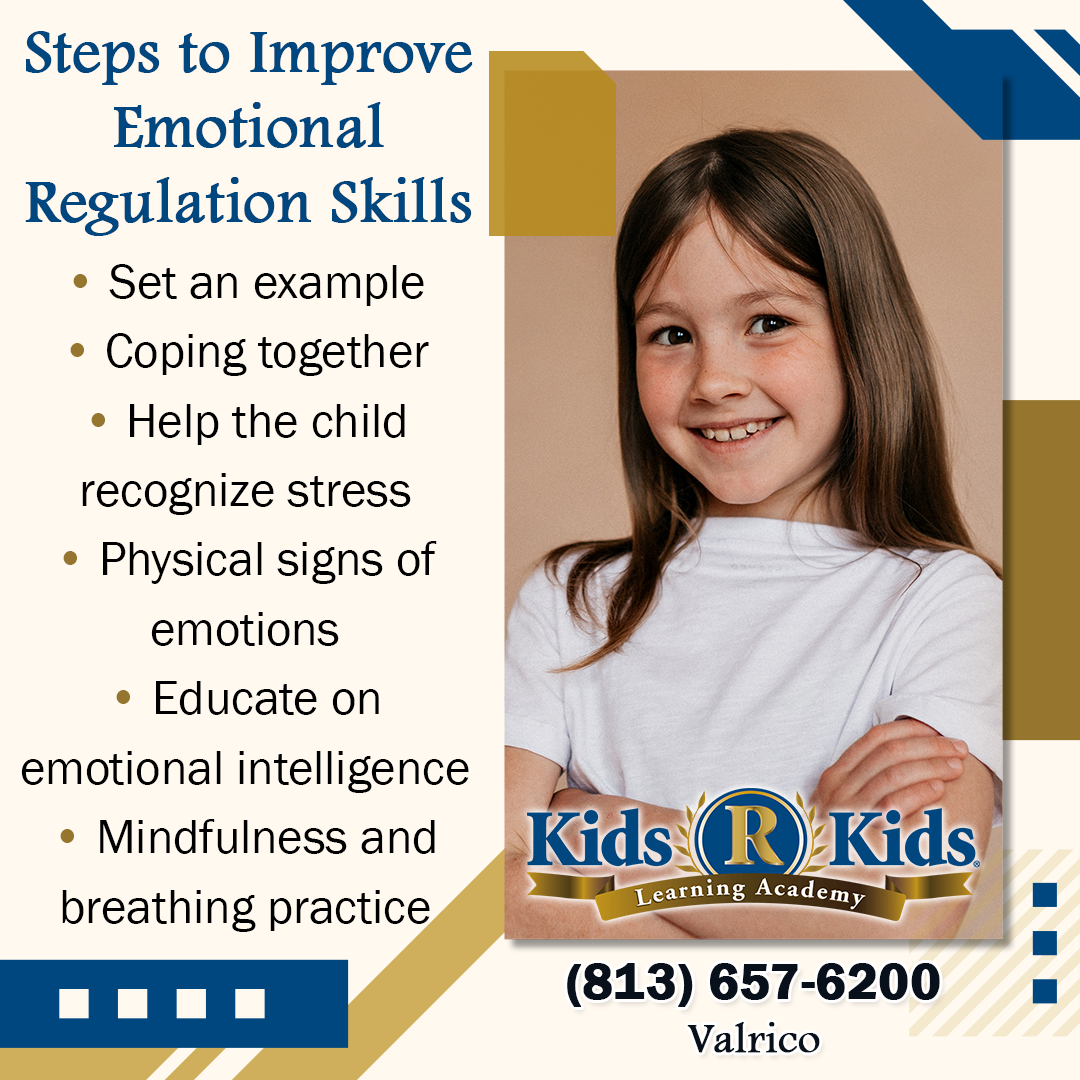
According to many studies, self-regulation is necessary for the social-emotional and academic success and well-being of a child. It is one of the most important life skills that parents and teachers must work together to build from an early age. Kids ‘R’ Kids Valrico, an educational preschool, shares below certain tips to help develop self-regulation skills in early childhood.
Self regulation is a person’s ability to manage emotions and behavior as per the demands of the situation. This set of skills enables children to inhibit their emotional or behavioral responses and direct their behavior towards a goal. For instance, controlling the urge to hit another child because their demands are not being met is a skill that needs to be slowly built. The ability to resist highly emotional reactions to upsetting stimuli, to calm oneself down when upset, to adjust to a change in expectations, and to handle frustration without an outburst is an important ingredient to living an emotionally stable and productive life. This skill helps to direct one’s behavior towards a fruitful end despite the unpredictability of the world and one’s feelings.
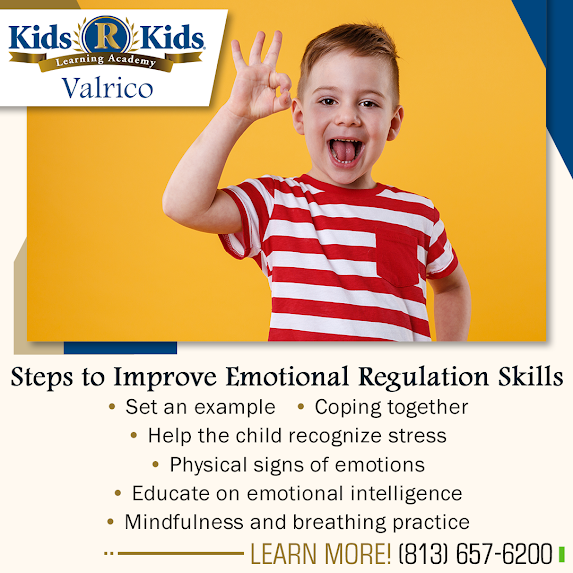
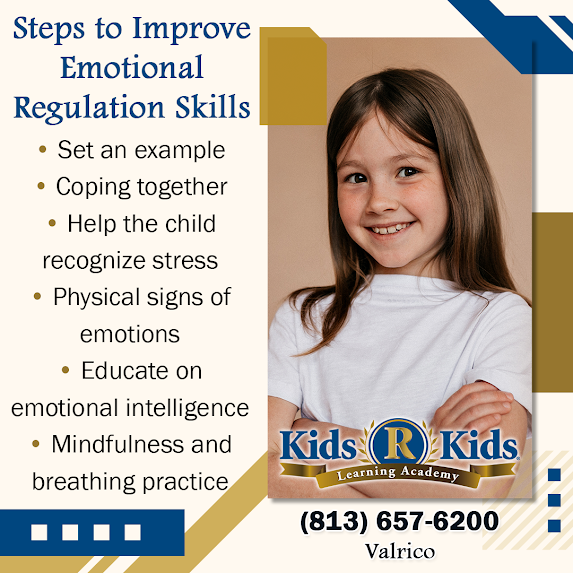
Children imitate what their caregivers do. So it is important to be a role model when it comes to emotional regulation. The way parents and caregivers handle daily stress is constantly being observed by the little ones. These are life skills and strategies for coping with problems that children start learning at a very young age.
Certain situations, environments, and sensations can trigger children and upset them. The reasons could be lack of sleep, hunger, loud noises, crowds, too much screen time, and disruption of routine. Recognizing the reasons that cause excessive stress to a child can help create awareness and empower the child as well as the caregiver by preparing them. Challenging behaviors such as whining, defiance, or emotional meltdowns can be prevented or mitigated if there is clarity on the triggers. This discovery of emotional triggers is also a common anger management activity for kids.
Emotional triggers can make children feel “out of control” and cause anxiety in its wake. But teaching a child to recognize their emotions, especially in the way they show up in their body helps to create self-awareness. The way emotions manifest in the body such as sweaty palms, racing heartbeat, and restlessness can be identified and checked before they take over completely.
Besides identifying the physical signs of certain emotional triggers, it is important to name the emotion. Emotional intelligence is defined as the ability to recognize, understand, and manage one’s emotions and the emotions of others.
An emotional vocabulary goes a long way in helping a child identify emotions and working through them. Visual tools can help children through early elementary ages to learn to manage their emotions.
Once an emotion and its triggers are identified, children need help with discovering healthy and productive outlets for these intense emotions. Every child’s unique nervous and sensory system means that the self-regulation trick would also be unique and will evolve. This requires some trial and error but it is worth exerting this effort. Some children may require physical touch when they are upset while some may resist it. Some children calm down in their own particular space while others need their caregiver’s company.
Generally, young children are physiologically helpless to calm down by themselves. Another effective approach to expanding a child’s emotional regulation skills is to practice co-regulation. This is active participation in helping a child deal with anger and other intense emotions by being present with them.
There is an undeniable connection between the body and mind. Besides maintaining consistent routines, mealtimes, and bedtimes as well as building healthy habits, caregivers can teach children the importance of breath. Research proves that deep, mindful breathing can calm the nervous system. Research on mindfulness shows that it strengthens the prefrontal cortex and one’s ability to regulate emotions and behaviors.
Simple mindfulness practices can help maintain a low baseline of emotional arousal in children. This calming strategy can also be used anywhere, anytime to help them manage their emotions and maintain their calm.
The philosophy of “Hug First, Then Teach”, defines every aspect of what Kids ‘R’ Kids, Valrico stands for. Unlike many daycare centers or childcare providers, its methodology is a whole-child approach. It constantly strives to strengthen and encourage every child’s emotional, intellectual, social, and physical well-being through the expertise of its childcare providers and a unique partnership with parents.
Kids ‘R’ Kids International is accredited by AdvancED®, the world’s largest education community, and the Southern Association of Colleges and Schools Council on Accreditation and School Improvement (SACS/CASI). SACS/CASI is an accreditation division of AdvancED®. This accreditation ensures that the high accreditation standards are met and exceeded.

Contact Information:
Kids 'R' Kids Learning Academy of Valrico
4321 Lynx Paw Trail
Valrico, FL 33596
United States
Ben Fernandes
(813) 657-6200
http://www.krkvalrico.com/
Research has proven that the most important period of human development is from birth to eight years old. Learning during these years happens at a pace that will never be matched. This is when cognitive skills, emotional well-being, social competence, and sound physical and mental health develops, laying a strong foundation for a successful adult. Kids ‘R’ Kids, Valrico, an educational preschool, shares the importance of structured and unstructured play for preschoolers that helps them prepare for formal school.
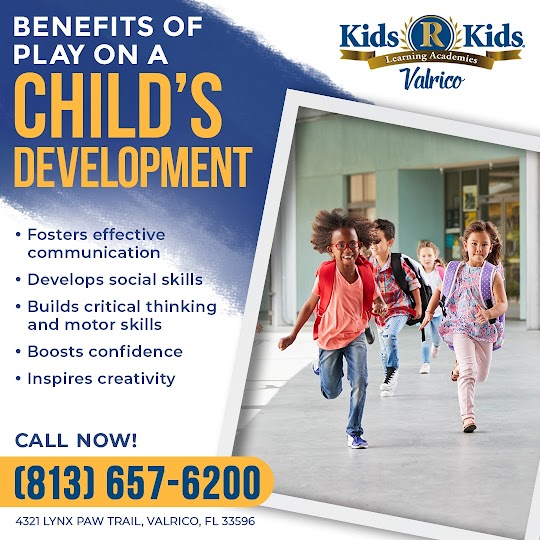
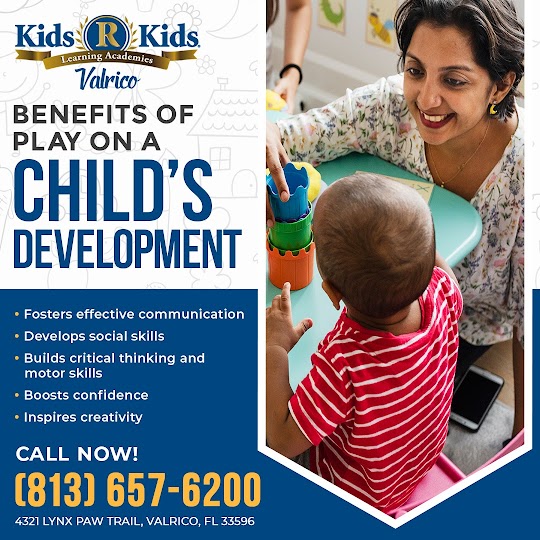
Structured play is also called goal-oriented or guided play. It is an activity that comes with structured instructions and has a specific learning objective for a preschooler. It is composed of planned activities that are supervised by adults - parents and teachers.
However, organizing every detail for children can hamper the development process. Children need to be allowed to use their imagination and individual creativity to learn and grow.
Unstructured play or free play is focused on creative, improvised forms of activity. It may involve both outdoor and indoor activities wherein the child can take decisions and solve problems independently. Activities may range from pretend play to building blocks and exploring a garden.
One major drawback of unstructured play is that the child cannot be left alone even for a moment and should be under the parent’s supervision at all times, especially the younger preschool kids. They must be educated about how to keep themselves safe and to recognize the possible dangers around them.
Play enables a child to develop important speech, language as well as listening skills. During play led by preschool teachers or parents, children need to listen to instructions and follow directions to complete a task. This ability to listen and understand helps build communication skills. During unstructured play and without any company children may narrate their pretend play story and practice the words and expressions learned. An unstructured group play will require the children to communicate, discuss, negotiate, and compromise. All this play leads to the development of effective communication skills and a teamwork spirit.
Unstructured as well as structured play drives children towards the achievement of a shared goal. The collaboration makes children perceptive of each other’s needs, builds assertiveness, teaches negotiation skills, develops cooperation skills, and reinforces the importance of sharing. Ultimately, this group play fosters social skills and children learn to make friends. Through play, children learn to work through their emotions and learn to recognize non-verbal cues, which are important components of language development and social skills.
Critical thinking is the ability to think in an organized and rational manner to understand connections between ideas and/or facts. This skill involves the part of the front part of the brain that manages attention, memory, control, and flexibility. Children are constantly making these connections in their world and expanding their knowledge. For instance, they learn numeracy and literacy skills while playing with various toys and books, or while playing with shapes, or counting the pages in a book.
Physical play is crucial for the development of important motor skills and emotion regulation. Large motor skills like running, throwing, and pedaling; fine motor skills such as writing, coloring, and buttoning; balancing skills like skipping; strength-building by climbing monkey bars; and coordination through sports are some of the numerous skills that emerge from play. Eventually, children become completely independent as their motor and other body skills develop.
Most play requires creativity, but imaginative play, in particular, is great for building confidence. It allows children to practice what they see in real life and work through real-world problems. Play is a safe place to practice decision-making and build confidence. Structured play enables children to participate in risky play and test what they are capable of. This is a test of their limits as they work towards their goals in a safe space. As they succeed in achieving their goals in a safe space, their confidence develops and allows them to step out of their comfort zone to learn more.
Creativity is the final sum of critical thinking and skill development. Pretend play is one of the foundations in children’s world as it allows them to explore and analyze various scenarios, reactions, and conclusions. It exposes them to cause and effect. As per studies, pretend play leads to more sophisticated levels of interaction and higher cognitive ability.
In conclusion, children need a mix of both structured and unstructured play during their developing years. Structured play provides rules, discipline, and continuity, while free play balances it out with freedom and imagination. Kids ‘R’ Kids, Valrico provides the ideal environment for preschoolers to learn through play and grow into creative, confident, and empathetic individuals.
The philosophy of “Hug First, Then Teach”, defines every aspect of what Kids ‘R’ Kids, Valrico stands for. Unlike many daycare centers or childcare providers, its methodology is a whole-child approach. It constantly strives to strengthen and encourage every child’s emotional, intellectual, social, and physical well-being through the expertise of its childcare providers and a unique partnership with parents.
Kids ‘R’ Kids International is accredited by AdvancED®, the world’s largest education community, and the Southern Association of Colleges and Schools Council on Accreditation and School Improvement (SACS/CASI). SACS/CASI is an accreditation division of AdvancED®. This accreditation ensures that the high accreditation standards are met and exceeded.
Call today at (813) 657-6200 to learn more about Kids 'R' Kids preschool (Kindergarten to Grade 5) or to schedule a visit.
In the United States, 1 in 5 children is unsupervised from 3 p.m. to 6 p.m. A quality after school program can turn those hours into a constructive learning opportunity. According to the Afterschool Alliance, a nonprofit organization, 94% of parents report that after school programs help their kids get excited about learning, which leads to improved school performance.
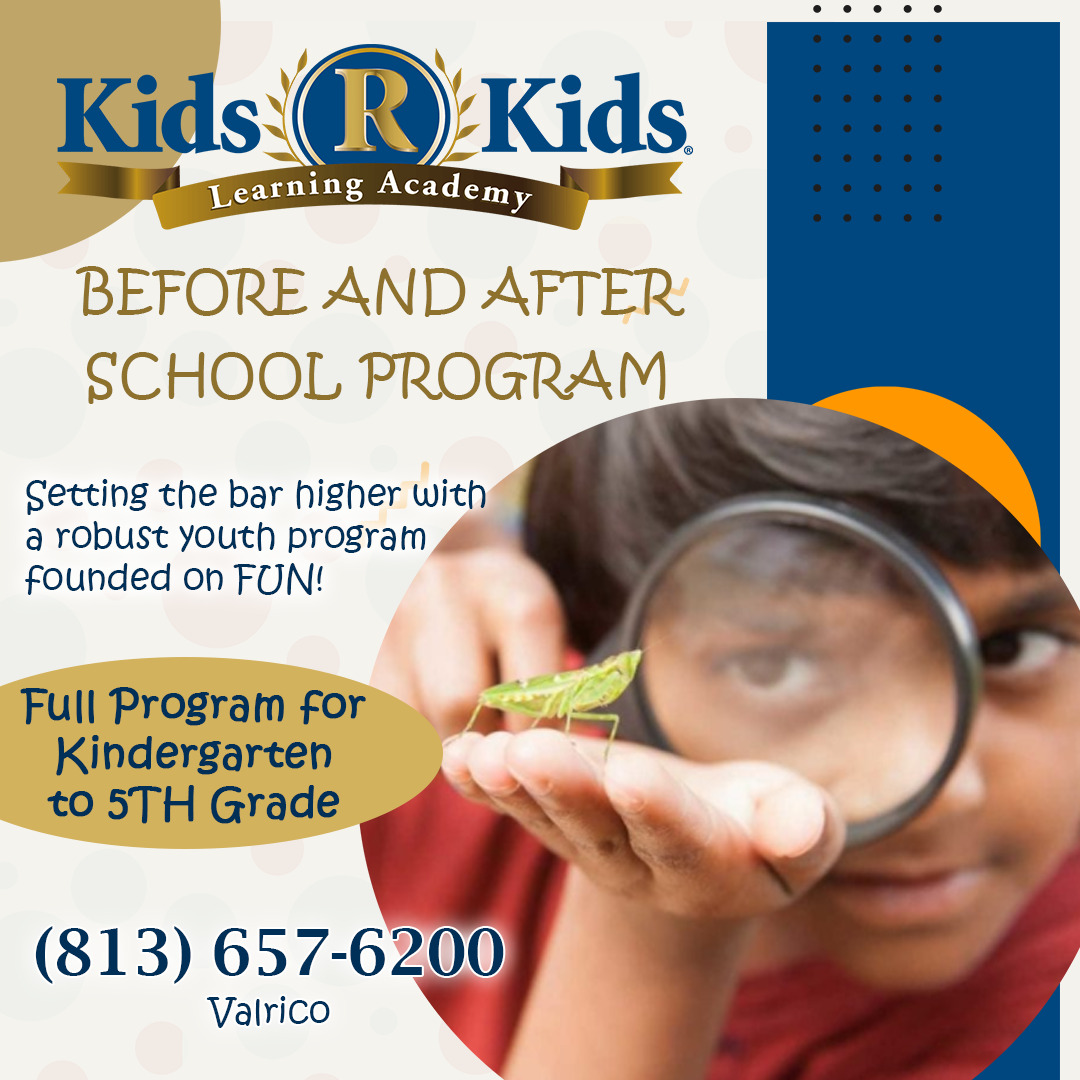
Before and after school programs are especially beneficial in strengthening the social, intellectual, emotional, and physical skills of Pre-K-age students. Florida recognizes the benefits of VPK programs (voluntary Pre-Kindergarten) by providing them to 4- and 5-year-olds at no cost, regardless of family income. When evaluating VPK programs, a family should choose a respected preschool like Kids ‘R’ Kids Learning Academy in Valrico, Florida, which offers much more than daycare programs.
Children who attend Pre-K programs are more likely to arrive at kindergarten with the skills needed for long-term academic and social achievement. Studies show that after-school programs support everything from increasing a child’s future earning potential to reducing delinquency. Pre-K schools like Kids ‘R’ Kids Learning Academy put young students on the path to success through an evidence-based curriculum that incorporates Pre-K games with Pre-K activities.
The top three benefits of Pre-K programs include:
A child’s brain grows exponentially in the years before kindergarten. A good Pre-K program relies on a Pre-K lesson plan that focuses on essential skills through hands-on learning. A program might combine a Pre-K sight words lesson with a game or art activity to engage a young child fully. Research shows that children who attended high-quality Pre-K programs are:
A child’s emotional and social health is essential for development and learning. Research shows that children with good mental health are more motivated to learn, make stronger friendships, and achieve higher academic performance as they age. A curriculum-based Pre-K program supports social and emotional growth through teaching children to:
Physical development also is key to a child’s learning ability. Pre-K programs support the development of fine motor skills that help children write, draw, and type. Learning through play supports whole-body movement to improve coordination and balance. Also, regular exercise through a Pre-K program can:
Hillsborough County residents who search for “daycares near me” should make sure to select a Pre-K program that focuses on encouraging academic, social, and physical growth through curriculum-based activities and games. Kids ‘R’ Kids Learning Academy, located at 4321 Lynx Paw Trail, Valrico, FL 33596, has years of experience, giving parents confidence that the program will prepare their children for kindergarten and future success.
Kids ‘R’ Kids Learning Academy offers a safe and secure environment that provides:

Interested parents should call Kids ‘R’ Kids Learning Academy today at 813-657-6200 or contact the academy online to plan a visit.
